

You’ve seen the "Workshop High."
It’s Friday afternoon. Your team just finished a two-day sales intensive. The energy is electric. They’re high-fiving in the hallways, quoting the frameworks, and promising to "crush it" come Monday. You feel like you’ve finally fixed the engine.
Then Monday morning hits.
By Tuesday, the new frameworks are buried under a pile of unreturned emails. By Thursday, the "discovery process" has devolved back into a 45-minute feature dump. By the following month, the $20,000 you spent on that "world-class" training is a line item on a budget sheet, providing zero ROI.
The workshop didn’t fail. Your follow-through did.
At Amaryllis Revenue Repair, we don't believe in band-aids. We believe in structural integrity. If you want to stop the leaks in your revenue, you have to stop treating sales improvement like an event and start treating it like a rhythm.
The Knowledge Decay Leak: Why One-Offs Fail
Most sales training is a "dump-and-run" operation. A consultant: often a junior with three years of experience and a fancy slide deck: shows up, talks at your team, and leaves.
Here is the cold, hard truth: Workshops change what people know. Coaching changes what they consistently do.
Research shows that without reinforcement, sales reps forget up to 80% of what they learned in a workshop within 30 days. That’s not a training problem; it’s a plumbing problem. You are pouring expensive knowledge into a broken pipe.
To fix the leak, you need more than a classroom. You need a "Frontline" approach. You need to transition from telling them how to sell to showing them how to win in rooms where losing isn't an option.
Coaching is a System, Not an Event
If you want a 38% revenue lift in your first year: the kind of results we deliver: you need to build a coaching culture that sticks. This isn't about "motivational talks" or checking in to ask "how's the pipeline looking?"
Real coaching is a structural fix. It involves four key stages:
1. Diagnose the Friction
We don't guess. We audit. We look at the call recordings, the CRM data, and the deal velocity. We find exactly where the deal dies. Is it a weak discovery? Is it an inability to multi-thread? Or is it a failure to tie the solution to a business outcome? Until you diagnose the specific leak, you’re just throwing tools at a wall.
2. Design the Rhythm
Coaching requires a "rhythm of execution." This means scheduled, non-negotiable 1:1 sessions that focus on deal strategy, not just pipeline inspection. If your managers are only asking "When is this closing?" they aren't coaching. They’re reporting.
3. Deploy in the Field
This is where the Frontline Intensive comes in. We don't just teach the theory; we ride along. We sit in on the calls. we handle the objections in real-time. We show the rep how to pivot when a prospect throws a curveball.
4. Deliver the Habit
Repetition is the mother of skill. A coaching culture is built when the team realizes that "good enough" isn't the standard. The standard is the framework, executed perfectly, every single time.
The Math of Mentorship: Why it Pays to Scale
Let's talk numbers. I have 40+ years of direct, founder-led experience. I’ve seen what happens when you move from a "manager" mindset to a "coach" mindset.
- 28% Higher Win Rates: Organizations with formal, long-term coaching programs see a massive jump in their ability to close.
- 88% Increase in Productivity: When a rep knows exactly what to do next, they stop wasting time on "ghost" deals and start focusing on high-probability opportunities.
- 72% Win Rate for Top Coaches: Front-line managers who effectively coach their teams drive win rates that are nearly double the industry average.
When you invest in coaching, you aren't just paying for advice. You are buying a faster sales cycle and a higher average deal size. You are buying the ability to scale without adding more "junior" chaos to the system.

Building the "Rhythm of Execution"
How do you turn a "broken" sales process into a well-oiled machine? You build a culture of accountability and continuous refinement.
- Stop the Pipeline Interrogation: Spend 80% of your time on the how and only 20% on the what.
- Implement "Post-Game" Reviews: Every lost deal is a diagnostic opportunity. Why did we lose? Where did the process break down?
- Use the Right Tools: Use your CRM as a map, not a graveyard. If the data in the CRM doesn't help you coach, the CRM is broken.
We see this every day at Amaryllis. Founders who are tired of the "sales roller coaster" realize that the problem isn't their product: it's their rhythm. They have the talent, but they don't have the discipline of execution.
The Amaryllis Approach: No Junior Consultants
When you work with us, you don't get a 24-year-old with an MBA and a checklist. You get me. You get the battle-tested wisdom of someone who has built, scaled, and repaired revenue engines for four decades.
We offer The Sales Lab, a comprehensive suite designed to fix your specific leaks:
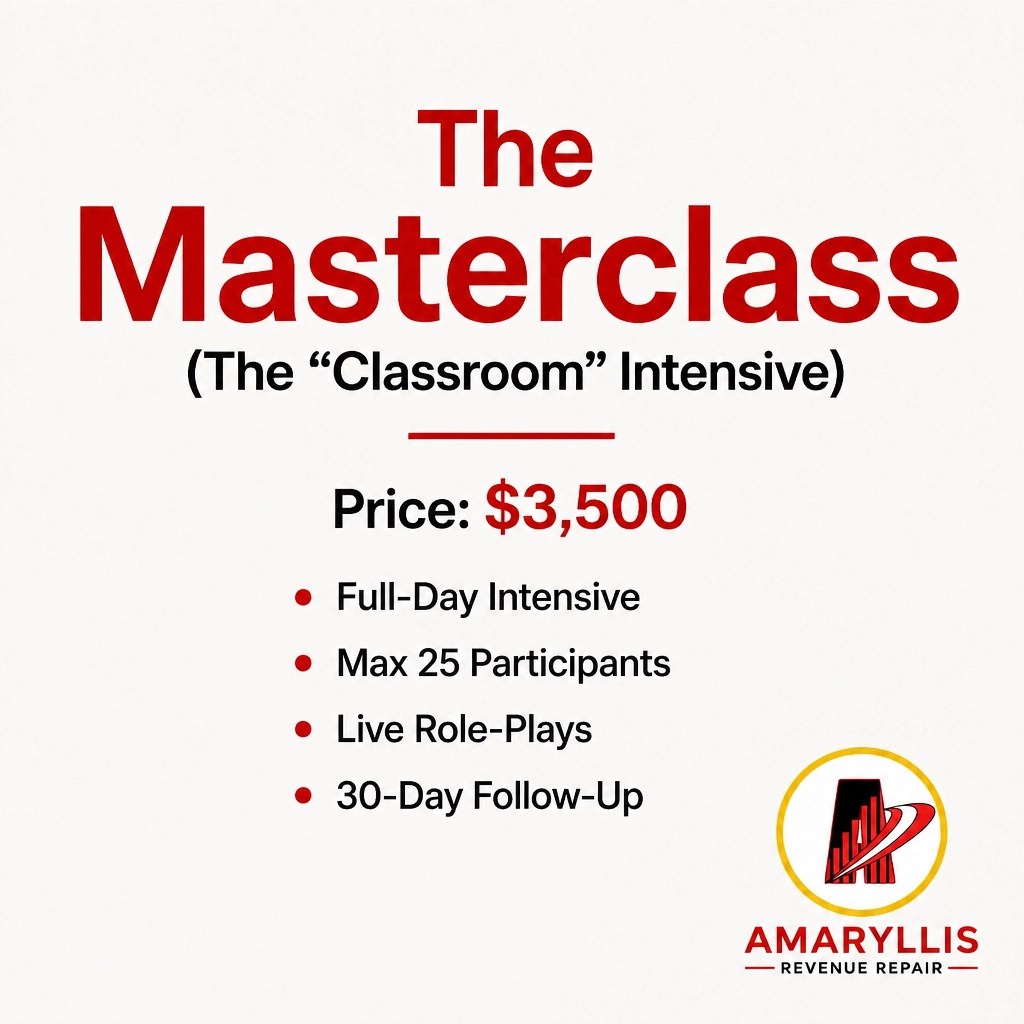
- The Masterclass: The high-intensity "classroom" for setting the foundation.
- The Frontline: The 3-week "ride-along" for cementing behavior in the real world.
- The Audit: A deep-dive diagnostic to find where your revenue is leaking.
We don't offer generic frameworks. We offer industry-tailored workshops and coaching that drive measurable, long-term results.
Repair the Leaks. Rebuild the Revenue.
A workshop is a spark. Coaching is the fuel that keeps the fire burning. If you’re tired of the "training high" followed by the "Monday morning slump," it’s time for a different approach.
Let’s find the revenue you’re leaving on the table. No pitch. Just a conversation about where your process is broken and how we can fix it.
Repair the leaks. Rebuild the revenue. Start today.
Leave a Reply