

Most founders are losing deals before they even open a slide deck.
You’ve built a product that works. You’ve got a market that needs it. You get the meeting. But somewhere between the "hello" and the "proposal," the momentum stalls. The prospect goes quiet. The "let me think about it" becomes a permanent status in your CRM.
After 40 years of selling in rooms where losing wasn't an option, I’ve seen this pattern repeat across a dozen industries. The culprit isn’t your pricing, and it isn't your product’s feature set. It’s your discovery call, specifically, the first 15 minutes.
If you aren't uncovering the friction in your prospect's business within that first quarter-hour, you aren't selling. You're just talking. And talking is expensive.
The Diagnosis: Why Discovery Is Broken
In most growth-stage companies, discovery calls are treated like a box to be checked. Founders often confuse "discovery" with "qualification" or, worse, a "pre-demo." They show up, ask three superficial questions about budget and authority, and then spend 45 minutes "feature dumping."
This is a massive revenue leak.

When you lead with the solution before you’ve fully diagnosed the problem, you position yourself as a commodity. You become a vendor, not a partner. At Amaryllis Revenue Repair, we don't believe in generic frameworks or junior-level observations. We believe in the "rhythm of execution." That rhythm starts with a surgical approach to discovery.
If you don't find the pain, you can't fix the leak.
The 5 Critical Leaks in Your Current Discovery Call
Before we look at the audit, let's identify the most common ways founders break their sales process early in the funnel:
- The "Premature Demo" Trap: You’re proud of what you built. We get it. But showing the product in the first 15 minutes is the fastest way to kill a deal. You are giving the prospect reasons to say "no" before they understand why they need to say "yes."
- The Talk-Time Imbalance: If you are talking more than 40% of the time, you aren't discovering. You're pitching. High-performing discovery calls are a lopsided conversation where the prospect is doing the heavy lifting.
- Asking What You Should Already Know: Asking "So, what does your company do?" in 2026 is an insult. It signals a lack of preparation and instantly devalues your expertise.
- No Up-Front Agreement: If the call doesn't start with a clear agenda and an agreement on what happens at the end, it will meander. Meandering doesn't lead to revenue.
- Surface-Level Pain: You ask "What keeps you up at night?" They give a canned answer. You move on. You haven't found the impact of the problem. If a leak isn't costing them money, time, or sleep, they won't pay to fix it.

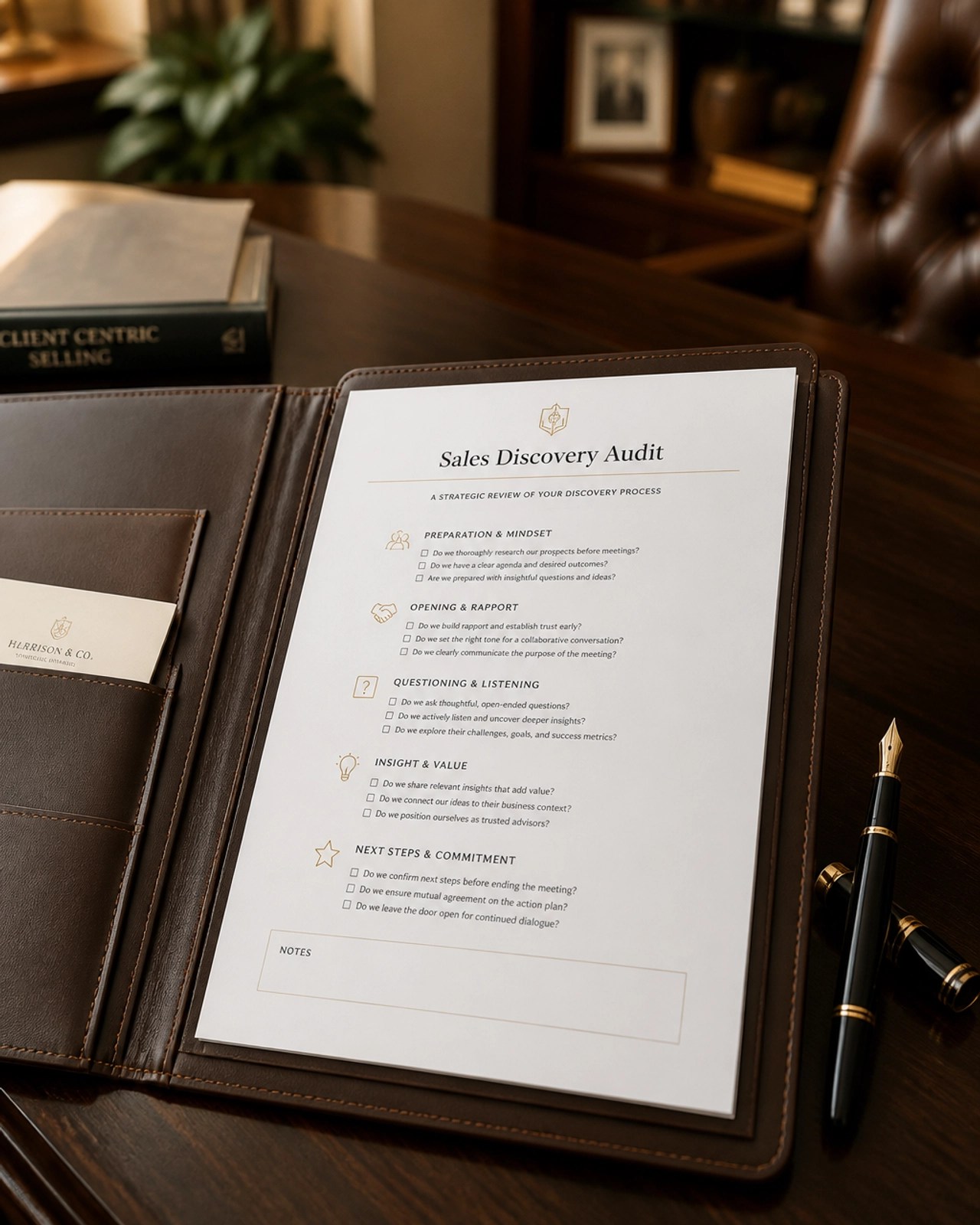
The "Discovery" Audit Checklist
To repair your close rate, you need to audit your calls with a "no-nonsense" lens. Use this checklist for your next five calls. If you can't check every box, your process is broken.
Phase 1: The Pre-Call Prep (The Blueprint)
- Targeting: Is this prospect actually in your ideal customer profile, or are you just hungry for a meeting?
- Intelligence: Have you spent 10 minutes on their LinkedIn, recent news, and financial reports? Do you know their "why" before they tell you?
- The Objective: What is the specific outcome you want? (Hint: "A second meeting" is too vague. "Agreement on a stakeholder workshop" is better.)
Phase 2: The First 15 Minutes (The Excavation)
- The Frame: Did you set an up-front agreement? "By the end of this 30 minutes, we’ll decide if it makes sense to move to a pilot or if we should shake hands and part ways. Does that work for you?"
- The "Why Now?": Did you uncover the trigger? Why are they looking for a solution today instead of six months ago?
- The Impact: Did you quantify the problem? If they say "we are slow," did you find out that "slow" is costing them $50k a month in missed opportunities?
- The Echo: Did you recap their pain in their words? If you can’t describe their problem better than they can, they won’t trust you to fix it.
Phase 3: The Close (The Next Step)
- The Decision Process: Do you know who else needs to sign off, and how they’ve bought similar tools in the past?
- The Calendar Lock: Did you leave five minutes at the end to put the next step on the calendar? Never leave a call with "I'll send you an email."
Repairing the Rhythm
A successful discovery call isn't about being likable; it's about being competent. It’s about acting as a "fixer" who can see the revenue leaks the prospect has become blind to.
At Amaryllis, we see an average 38% revenue lift in the first year with our clients. We don't achieve that by teaching "tips and tricks." We achieve it by diagnosing and designing the fundamental sales processes that drive growth. Whether through Sales Outsourcing or our Sales Lab training, we focus on the "shoulder-to-shoulder" work that produces measurable results.
If your discovery calls feel like a struggle, it’s a sign that your go-to-market strategy is misaligned. You’re likely selling to the wrong people or using a framework that’s too theoretical for the real world.
Stop Leaving Revenue on the Table
You don’t need more leads. You need to close the ones you have.
Repair the leaks. Rebuild the revenue. It starts with those first 15 minutes.
If you're ready for a straight-talk assessment of your sales process, let’s talk. We offer a Sales Audit: a $1,000 one-time starter blueprint where we look at your numbers, listen to your calls, and pinpoint exactly where your revenue is leaking. No pitch. Just the facts.

Let's find the revenue you're leaving on the table.
Leave a Reply